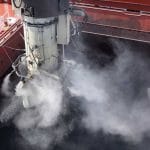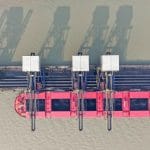




A fertilizer ship loader is specialized bulk port machinery engineered exclusively for continuous, automated loading of granular and powdery fertilizer materials onto cargo vessels and barges. Unlike general-purpose ship loaders designed for coal, ore or grain, fertilizer-specific ship loaders are optimized to address the unique physical and chemical properties of fertilizers, including fine particle dust generation, material fragility, moisture sensitivity, and easy caking characteristics. It serves as the core terminal equipment for fertilizer export terminals, chemical port yards, and large-scale fertilizer manufacturing logistics bases, effectively solving the loading bottleneck in bulk fertilizer maritime transportation.
In the global agricultural supply chain, bulk fertilizer transportation accounts for over 80% of cross-border fertilizer trade volume. Traditional manual loading and semi-automatic loading methods suffer from low efficiency, severe material waste, serious dust pollution, and unstable loading accuracy, which greatly restrict the shipping capacity of fertilizer enterprises. The modern fertilizer ship loader completely changes this situation through fully enclosed conveying, intelligent flow control, and flexible ship position adaptation, becoming indispensable core equipment for standardized and green fertilizer port operation.
Whether for small and medium-sized inland river barges or large ocean-going bulk carriers up to 50,000 DWT, a qualified fertilizer ship loader can match different loading tonnage requirements, realizing continuous loading operations from yard stockpiles to ship holds. It covers mainstream fertilizer types such as urea, compound fertilizer, ammonium sulfate, potassium fertilizer, and blended granular fertilizers, adapting to diverse production and transportation needs of the fertilizer industry.
The operation logic of a fertilizer ship loader follows a stable and continuous bulk material conveying cycle, with highly systematic and standardized working procedures. The entire loading process realizes unmanned automatic operation through the coordination of feeding systems, conveyor systems, telescopic boom mechanisms, dust-proof chutes, and intelligent control systems.
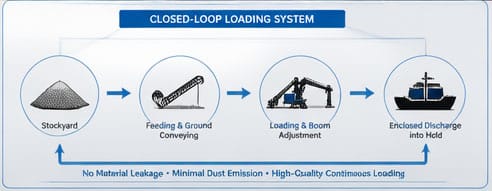
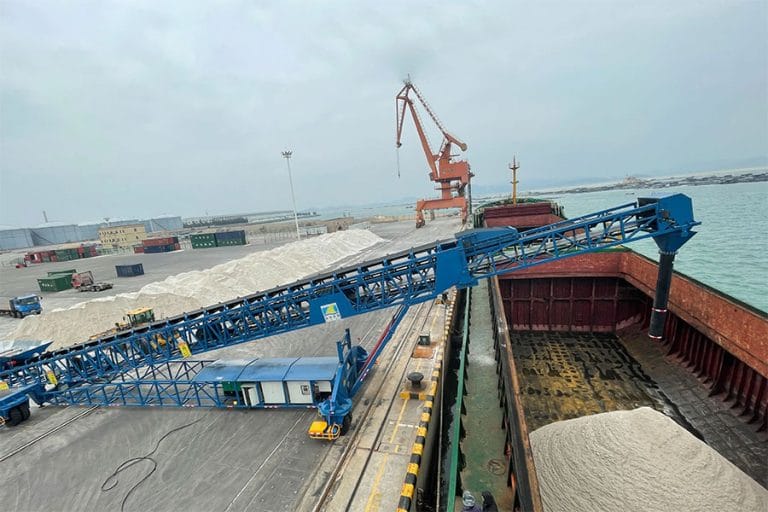
First, bulk fertilizer materials in the port stockyard are evenly fed into the ground belt conveyor system through quantitative feeding hoppers and buffer silos. The feeding system is equipped with frequency conversion speed regulation devices to ensure stable material supply and avoid material accumulation or intermittent feeding that affects loading efficiency. Then, the materials are stably transported to the tail car of the fertilizer ship loader via the fixed or mobile ground conveyor belt.
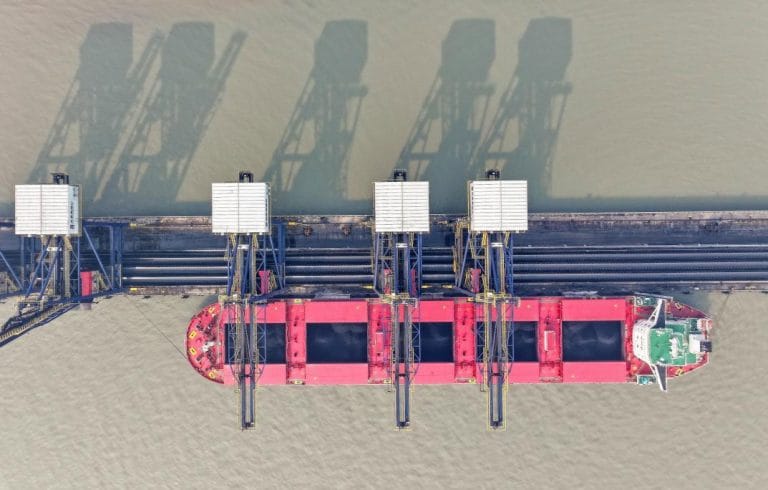
Next, the loader’s main conveyor belt lifts the materials to the telescopic slewing boom mechanism. The boom can realize horizontal slewing, telescopic extension and vertical lifting adjustment, enabling the discharge chute to accurately cover all hatch positions of the ship hold. This flexible adjustment function eliminates the need for frequent ship position adjustment, greatly saving berthing time.
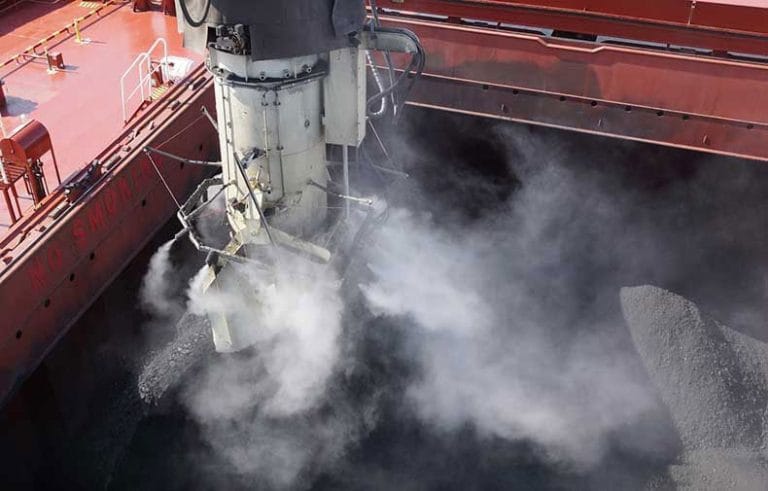
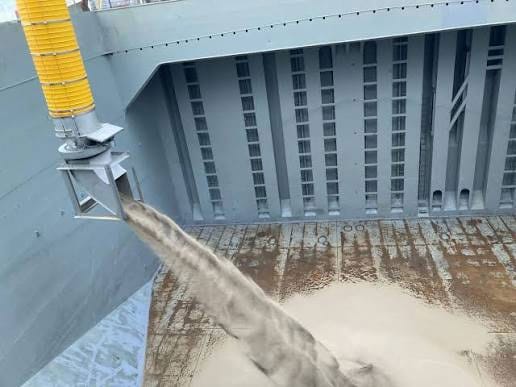
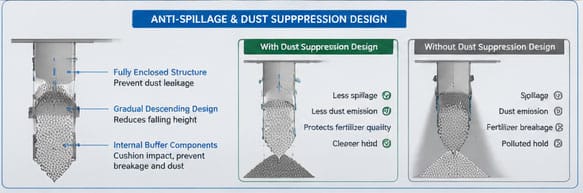
Finally, fertilizers pass through the fully enclosed telescopic discharge chute and fall evenly into the ship hold. The core design of the fertilizer-specific chute is the anti-spillage and dust suppression structure. With the gradual descending design of the chute and internal material buffer components, it effectively reduces the material falling height, prevents granular fertilizer breakage, and avoids powdery fertilizer dust flying. The whole process forms a closed-loop loading system with no material leakage and minimal dust emission, realizing high-quality continuous loading.
According to structural forms, walking modes and application scenarios, fertilizer ship loaders are mainly divided into three mainstream types, each with unique advantages and applicable terminal conditions, providing targeted solutions for different fertilizer loading demands.
| Loader Type | Structural & Operational Features | Loading Capacity & Vessel Compatibility | Core Advantages | Applicable Scenarios |
|---|---|---|---|---|
| Fixed Fertilizer Ship Loader | Fixed installation at dedicated quay berths with no walking function; relies on slewing and telescopic boom adjustment to cover ship hatches; ultra-stable integral steel structure with fewer movable parts | Stable conventional loading capacity; compatible with fixed-type bulk vessels and regular berthing ships; no limit on single-batch loading volume | Extremely low mechanical wear and failure rate; high operational safety and running stability; simple daily maintenance; long service life; stable continuous loading performance | Professional exclusive fertilizer terminals, fixed-berth large-scale fertilizer export bases, large chemical fertilizer factory supporting wharves with single-variety and large-batch long-term loading demands |
| Rail-Mounted Mobile Fertilizer Ship Loader | Equipped with rail walking bogies at the bottom, capable of horizontal movement along quay tracks; flexible boom slewing and telescoping; covers multiple berths with one single device | Conventional throughput: 300t/h – 1500t/h; adaptable for 800 DWT to 50,000 DWT bulk carriers and barges | High equipment utilization rate; flexible berth switching; balanced efficiency and cost; strong site adaptability; suitable for mixed bulk cargo operation | Comprehensive bulk cargo ports, multi-functional fertilizer logistics terminals, medium and large-sized public wharves with multi-ship and multi-batch alternate loading demands |
| Radial Telescopic Mobile Fertilizer Ship Loader | Integrates radial rotation, full-range telescopic extension and flexible walking technologies; supports intelligent automatic positioning; equipped with independent dust removal and closed conveying systems | High-efficiency throughput up to 3000t/h; full coverage of all ship hatches without vessel position adjustment; compatible with all mainstream fertilizer transport vessels | Superior operational flexibility; ultra-high loading efficiency; excellent dust-proof and environmental protection performance; intelligent unmanned operation support; extremely low material breakage rate | High-standard green environmental protection terminals, international large-scale fertilizer export ports, high-efficiency transshipment hubs with strict environmental protection and high-throughput requirements |
In summary, users can select the optimal fertilizer ship loader model based on actual berth conditions, daily loading throughput, vessel types, and local environmental protection policies. Fixed loaders prioritize stability and low maintenance, rail-mobile loaders balance flexibility and cost-effectiveness, and radial telescopic loaders focus on high efficiency and green environmental protection, fully covering all market application demands for fertilizer ship loading equipment.
Compared with ordinary bulk cargo ship loaders and traditional loading equipment, professional fertilizer ship loaders have targeted optimized advantages in environmental protection, efficiency, material protection and cost control, which perfectly fit the characteristics of fertilizer logistics.
Fertilizers, especially powdery compound fertilizers and fine urea particles, are prone to dust flying during loading, which not only causes material loss but also pollutes the port environment and endangers the health of operators. The fertilizer ship loader adopts fully enclosed conveying pipelines and telescopic dust-proof chutes, matched with centralized dust extraction devices, which can effectively suppress dust generation. The closed loading structure avoids contact between fertilizers and external humid air, preventing fertilizer moisture absorption and caking, ensuring fertilizer quality stability during loading.
The continuous automatic loading mode completely breaks the efficiency limit of intermittent manual loading. The conventional fertilizer ship loader can stably maintain a loading efficiency of 500–1200 tons per hour, and high-power models can reach 1500 tons per hour or higher. The intelligent flow control system realizes precise quantitative loading, avoiding repeated weighing and material adjustment. It greatly shortens the ship’s berthing and loading cycle, improves the berth turnover rate, and creates greater economic benefits for port terminals and fertilizer export enterprises.
Granular fertilizers are easy to break and powder due to impact and friction during transportation, which affects product grade and market sales. The fertilizer ship loader is designed with buffer feeding and slow descending chute structures, which reduce material impact force in the loading process, effectively controlling the fertilizer breakage rate within a very low range. It ensures uniform fertilizer particle size and complete product appearance, improving the market competitiveness of exported fertilizer products.
Modern fertilizer ship loaders adopt standardized modular structure design, with stable mechanical performance and low failure rate. The automated operation system reduces manual participation, saving a lot of labor costs. The wear-resistant and anti-corrosion materials are used in key parts, adapting to the corrosive environment of chemical fertilizers, extending the service life of equipment, and reducing long-term maintenance and replacement costs for enterprises.
Fertilizer ship loaders are widely used in the whole industrial chain of fertilizer production, warehousing and maritime transportation, covering multiple core scenarios.
First, it is applied to supporting terminals of large chemical fertilizer factories. Many domestic and international large-scale urea and compound fertilizer manufacturers are equipped with dedicated shipping terminals. The fertilizer ship loader realizes direct loading from factory stockpiles to ships, eliminating intermediate handling links, reducing material loss and transportation costs, and realizing integrated production and shipping operations.
Second, it is used for professional bulk fertilizer logistics terminals. These terminals undertake centralized warehousing, transshipment and export of bulk fertilizers from multiple manufacturers. The high-flexibility mobile fertilizer ship loader can adapt to different ship types and fertilizer varieties, realizing efficient transshipment operations and improving terminal operation capacity.
Third, it is suitable for inland river and coastal small and medium-sized fertilizer shipping wharves. The compact and flexible small-tonnage fertilizer ship loader is tailored for inland river barge transportation, with low equipment investment and simple operation, meeting the bulk transportation demands of regional fertilizer markets.
To select a suitable fertilizer ship loader, enterprises need to comprehensively consider terminal conditions, transportation demands and material characteristics to avoid equipment mismatch and resource waste.
First, confirm the loading capacity demand. According to daily and annual fertilizer export volume, select 300t/h, 800t/h, 1200t/h or 1500t/h models to match the terminal’s throughput pressure. Second, match the ship type specification. Determine the loader’s boom length, lifting height and walking range according to the main DWT of docked ships to ensure full coverage of loading hatches.
Third, focus on environmental protection configuration. For coastal and urban surrounding terminals with strict environmental protection requirements, priority should be given to fully enclosed dust-proof models with supporting dust removal systems. Fourth, consider equipment mobility demands. Fixed loaders are preferred for single-berth professional terminals, while rail-mobile loaders are more cost-effective for multi-berth comprehensive terminals.
As the core intelligent equipment of bulk fertilizer maritime logistics, the fertilizer ship loader solves many pain points of traditional fertilizer loading operations such as low efficiency, serious dust pollution, large material loss and poor product quality control. With the continuous upgrading of global environmental protection policies and the continuous expansion of cross-border fertilizer trade, automated, green and high-efficiency fertilizer ship loaders have become the standard configuration of modern fertilizer terminals.
Choosing a high-quality fertilizer ship loader can not only significantly improve port loading efficiency and ship turnover rate, but also reduce operating costs, optimize environmental protection benefits, and ensure stable and high-quality output of fertilizer export business. For fertilizer production enterprises and port terminal operators, investing in professional fertilizer ship loading equipment is an important measure to enhance core competitiveness and adapt to the standardized development of the bulk logistics industry.