



Request Quote - Fertilizer

Contact Details


Project Specifications


Commercial & Files


Request a Free MSL Quotation

Request a Free Quotation

Ready to move forward? Provide your key requirements below, and we'll send you a detailed quotation within 24 business hours.


Contact Details


Equipment Requirements


Commercial Terms


Get Customized MSL Solution

Get Your Customized Mobile Shiploader Solution

Tell us about your port and material handling needs. Our engineers will analyze your requirements and respond with a tailored proposal within 24 hours.


Your Contact Information


Your Application


Site Conditions


Additional Requirements


Leave a message

Ship Loading Systems

Integrated bulk ship loading systems — from equipment supply to EPC delivery for coal, mineral, sugar, grain and fertilizer terminals. Capacity 100–6,000 TPH, engineered for Supramax, Panamax and barge operations.

Why Work With Us?

We build and deliver small-to-medium-capacity ship loading systems that fit the way real terminals operate — not just a catalog of machines.

Right-sized for medium bulk terminals

100–6,000 TPH engineered for Supramax, Panamax and barge operations — no over-building, no shortfall.

One interface, full responsibility

In-house manufacturing, erection support, commissioning and after-sales. You coordinate with one team.

Flexible engagement

Supply the equipment only, or hand us the whole terminal — EPC from layout study to commissioning.

One supplier. One interface. One responsibility.
What’s in the System

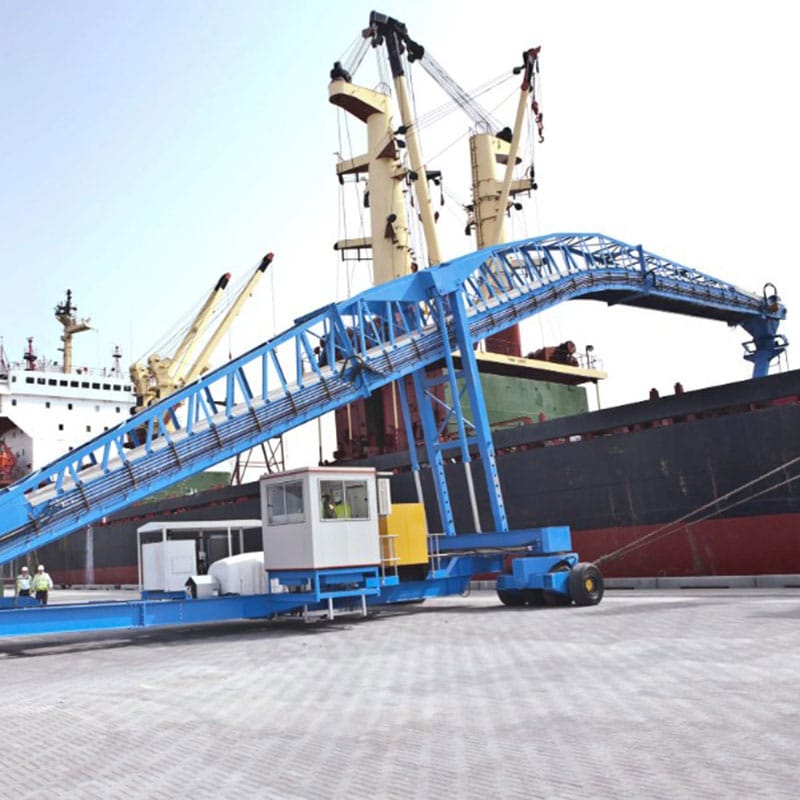
Your ship loading system, delivered as one package:

Material feed interface​ — hopper, feeder and connection to your stockyard conveyor
Shiploader main unit​ — wheel-mounted, crawler-mounted or rail-mounted, as required
Telescopic loading chute & spoon​ — adjustable coverage for different hatches
Dust suppression system​ — enclosed chute with water spray / fogging, tuned to local environmental requirements
Electrical & control​ — PLC + HMI + VFD, with safe load-weighing and auto-trim where specified
Optional extensions​ — mobile hopper, conveyor lengthening, barge loading kit

Solution Types of Our Ship Loading Systems

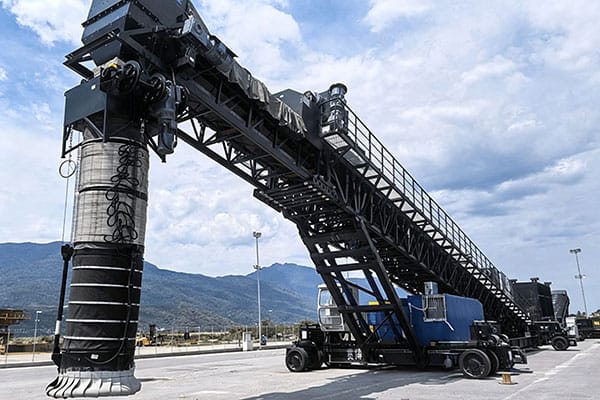
Wheel-Mounted Ship loading Systems
Best for: flexible transfer between berths, limited headroom or confined terminal space. Moves on its own wheels — no rail track required.
wheel mounted ship loading systems

Capacity: 300–3,500 TPH

Travelling / Rail-Mounted Ship loading Systems
Best for: fixed jetty, multi-ship operations. Boom luffing, slewing and radial travel for full-hatch coverage.
Travelling Rail Mounted Shiploader System

Capacity: 2,000–6,000 TPH

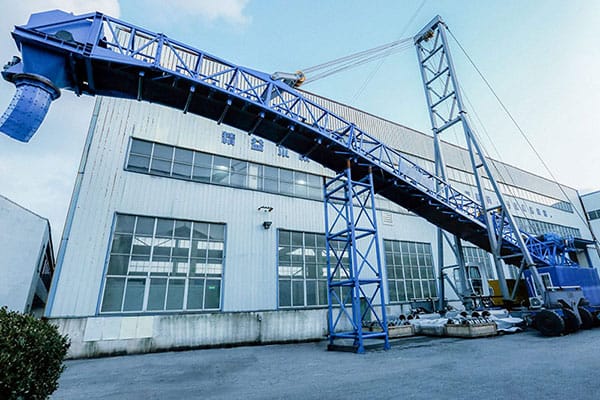
Barge Loading System
Best for: inland river ports, no deep-water quay. Low-clearance, compact layout.
Barge Loading System

Capacity: 100–1500 TPH

Engineering & Design Standards

We don’t just build machines — we engineer systems that pass port authority reviews, classification society approvals, and decades of operational stress. All ship loading systems we deliver are designed, calculated and documented to internationally recognized standards, with localization for your country’s regulations.

Structural Engineering

  • Capacity range:​ 100 – 6,000 TPH (adjusted for material density)
  • Vessel coverage:​ Supramax / Panamax / barge, 1,000 – 100,000 DWT
  • Structural design:​ FEM / DIN / ISO
  • Electrical & control:​ IEC / IEEE, PLC + HMI + VFD
  • Dust control:​ enclosed chute + water spray / fogging, compliant with local environmental regulations
  • Localization:​ design adapted to client’s country and port conditions (e.g. port authority requirements)

Mechanical Systems

  • Drive systems:​ variable frequency drives (VFD) on all main motions — travel, luffing, slewing, conveyor — for soft start/stop and precise positioning
  • Belt conveyor:​ designed per CEMA / ISO 5048, with self-aligning idlers, belt scale integration and emergency pull-cord safety
  • Telescopic chute:​ multi-stage, counterweighted or hydraulically actuated, with internal baffles to control material free-fall and dust generation
  • Luffing & slewing:​ hydraulic cylinder or rope winch luffing; roller-slewing ring or pinion drive slewing — selected per capacity and duty class
  • Braking & safety:​ spring-applied hydraulic-released brakes on all motions; storm anchors and rail clamps for travelling units
  • Access & maintenance:​ full walkways with handrails, non-slip grating, platform lighting, and designated access for lubrication points and bearing inspection

Electrical & Automation

  • Standards:​ IEC / IEEE / NEMA — voltage and frequency adapted to client’s local grid (e.g. 380V/50Hz, 440V/60Hz)
  • PLC & HMI:​ Siemens / Schneider / ABB (brand per client preference) — central PLC with operator HMI at cabin and remote monitoring option
  • Variable Frequency Drives:​ on all conveyor and travel motors for smooth acceleration and energy recovery where applicable
  • Load & safety systems:​ load cells on boom and chute for real-time weight monitoring; anti-two-block, overload cut-off, and safe working load (SWL) display
  • Draft & trim control:​ auto-trim logic available for even distribution of cargo in vessel holds, reducing ship turnaround time
  • Communication:​ PROFIBUS / Modbus / Ethernet IP fieldbus; remote access via VPN for diagnostics and support

Dust Suppression & Environmental

  • Enclosed transfer points:​ all material transfer zones (feed inlet, boom conveyor discharge, chute entry) fully enclosed with rubber skirts and inspection doors
  • Telescopic chute sealing:​ flexible canvas or rubber bellows between stages to prevent dust escape during extension/retraction
  • Water spray / fogging system:​ atomized water mist at chute inlet and discharge, with solenoid control linked to material flow
  • Compliance target:​ designed to meet local EPA / environmental authority limits (e.g. < 10 mg/Nm³ at source, or as specified by port authority)
  • Spill containment:​ drip trays and collection hoppers at transfer points, with clean-out access

Localization & Compliance

  • Port authority approval:​ drawings and calculations submitted for client’s local port authority and classification society review (e.g. DNV, BV, ABS, IRS, INMETRO)
  • Country-specific adaptation:​ electrical components selected for local availability and serviceability; control language and documentation in English + [local language if required]
  • Certification:​ CE marking where applicable; GOST / INMETRO / SASO or other regional certifications on request
  • Documentation package:​ GA drawings, detail drawings, calculation reports, O&M manuals, spare parts list, test certificates, and as-built dossier — all in digital + hard copy

Quality Assurance

  • Manufacturing QA:​ ISO 9001-certified processes; NDT (MPI / UT / DPT) on critical welds; dimensional inspection reports (IR) for all machined fits
  • Factory acceptance test (FAT):​ dry run and function test of all motions at our workshop before shipment
  • Site acceptance test (SAT):​ performance test with material at rated capacity (100–6,000 TPH) at client’s terminal
  • Warranty:​ One year on mechanical and electrical components; extended warranty and AMC available

How We Deliver

Equipment Supply Only

You already have the jetty, civil works and possibly existing conveyors. We supply the ship loading systems, erection drawings, on-site supervision, commissioning support and spare parts — and we train your crew.

EPC Turnkey

From the first layout study to final commissioning and handover. We design, manufacture, install and commission the complete ship loading systems as part of your terminal project.

Tell us what you have today — we adapt the contract to fit.
Project References

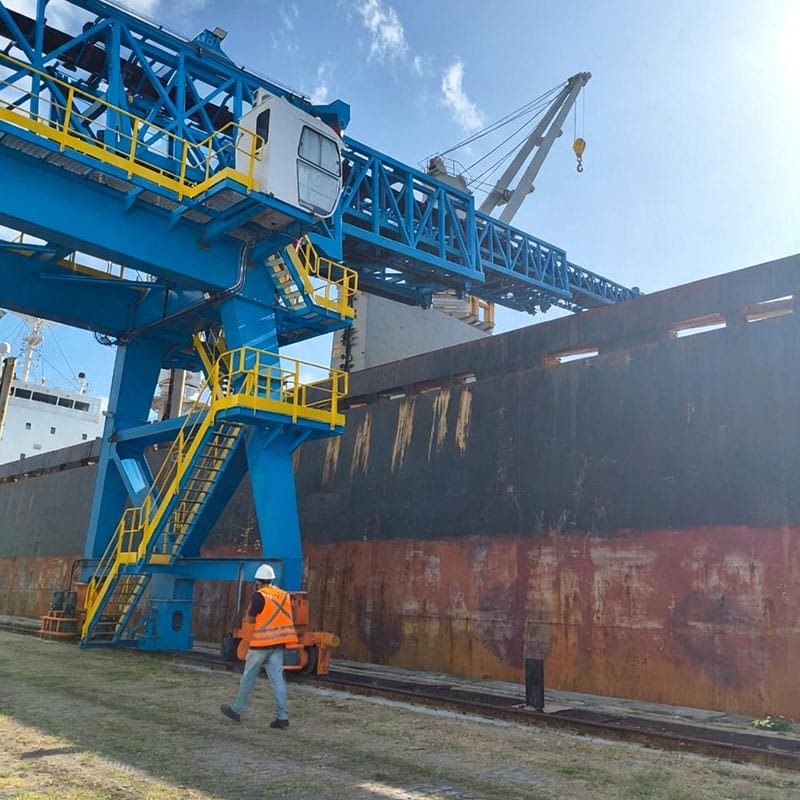
Case 1 — Pet Coke Shiploader, Brazil
  • Project:​ Pet Coke Ship Loading System
  • Location:​ Brazil
  • Material:​ Pet coke
  • Capacity:​ 1,000 TPH
  • Configuration:​ Wheel-Mounted Shiploader
  • Engagement:​ Equipment Supply
  • Challenge:Limited terminal space and headroom required a self-propelled unit that could move between berths without additional civil works.
  • Result: Delivered a wheel-mounted shiploader that achieved stable 1,000 TPH loading with controlled dust output, ready for operations shortly after delivery.
Pet Coke Shiploader
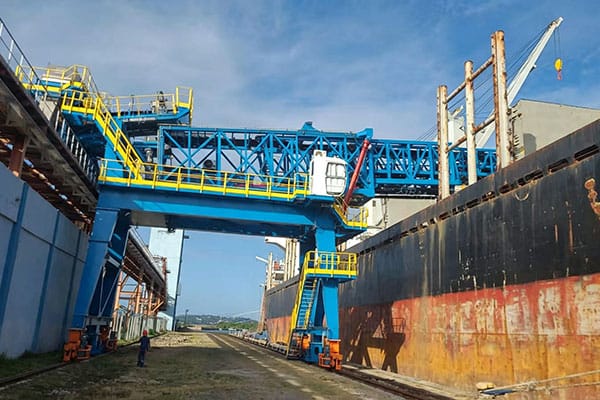
Case 2 — Sugar Shiploader, Brazil
  • Project:​ Sugar Ship Loading System
  • Location:​ Brazil
  • Material:​ Sugar (food-grade bulk)
  • Capacity:​ 2,000 TPH
  • Configuration:​ Rail-Mounted Shiploader
  • Engagement:​ Equipment Supply
  • Challenge: Sugar loading demands hygiene and clean operation — the system had to minimise contamination risk and support precise hatch placement.
  • Result: A rail-mounted shiploader with enclosed, low-dust handling delivered consistent 2,000 TPH performance and met food-grade operational standards.
Sugar Shiploader, Brazil
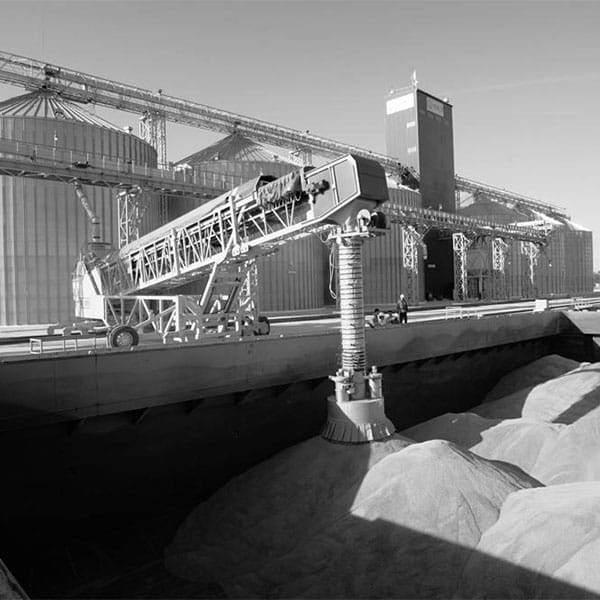
Case 3 — Fertilizer Shiploader, Iran
  • Project:​ Fertilizer Ship Loading System
  • Location:​ Iran
  • Material:​ Fertilizer (bulk granular)
  • Capacity:​ 800 TPH
  • Configuration:​ Wheel-Mounted Shiploader
  • Engagement:​ Equipment Supply
  • Challenge: Fertilizer handling requires free-flowing, low-dust material transfer — the chute geometry and conveyor feeding had to prevent bridging, clogging and product degradation.
  • Result: A wheel-mounted shiploader delivered reliable 800 TPH service with minimal product loss and dust emission, suited to granular fertilizer bulk handling.
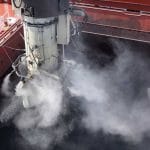
Fertilizer Shiploader, Iran

Project insight:

Three projects, two continents, two capacity bands — 800–2,000 TPH. Same wheel-mounted platform proven in Brazil and Iran; rail-mounted platform added for food-grade sugar. Whatever your terminal, we match the right mobile platform and material handling to the job.

Technical Highlights

ParameterDetail
System Capacity100 – 6,000 TPH
Vessel SizeSupramax / Panamax / barge, 1,000 – 100,000 DWT
Shiploader TypeWheel-Mounted / Crawler-Mounted/Rail-Mounted
Boom Length15 – 40 m (depending on configuration)
Dust ControlEnclosed chute + water spray / fogging
Control SystemPLC + HMI + VFD
Design StandardsFEM / DIN / ISO (structure); IEC / IEEE (electrical)
EngagementEquipment Supply or EPC Turnkey
Delivery120 days for standard models

Helpful Answers To Your Questions

What exactly is included in your ship loading systems?

Depending on the engagement model, we cover the full chain — material feed interface, shiploader main unit, telescopic chute, dust suppression, electrical & control, erection drawings, on-site supervision, commissioning support and training. For EPC projects we add design, civil coordination and project management.

Equipment supply means you provide the jetty and civil works; we deliver, install support and commission the loading system. EPC means we take the whole terminal scope from layout study to handover.

Yes. We interface with your existing conveyors and hoppers — tell us your layout and we match the feed connection.

Enclosed chute plus water spray / fogging, tuned to the material and to local environmental requirements. For free-flowing bulk like fertilizer, chute geometry and feeding are designed to prevent bridging, clogging and product degradation.

Yes. We provide on-site supervision, commissioning support and operator training for projects all over the world.

It depends on berth layout, headroom and mobility needs. Wheel-mounted for flexible berth-to-berth transfer with no rail track; rail-mounted for fixed multi-ship jetty operations. We help you decide.
Tell us your terminal — we’ll scope the system.

Ship Loading Systems

Newsletter Subscribe!

Stay ahead of the curve. Subscribe to our newsletter for expert analysis and industry trends, curated just for professionals like you.
Newsletter Subscribe

Have more questions?

Let’s schedule a short call to discuss how we can work together and contribute to the success of your project or idea.